On December 3, 2024, the 12th China SIF Annual Conference was successfully held in Beijing. The conference was hosted by SynTao Green Finance, with co-hosts from the United Nations Environment Programme Finance Initiative (UNEP FI) and the United Nations Sustainable Stock Exchanges Initiative (UN SSE). Many experts from regulatory bodies, markets, academia and international organisations expressed their views and discussed the 20-year development of ESG investment and the opportunities and challenges of responsible investment in China. The event attracted over 300 in-person participants and drew approximately 550,000 online views.
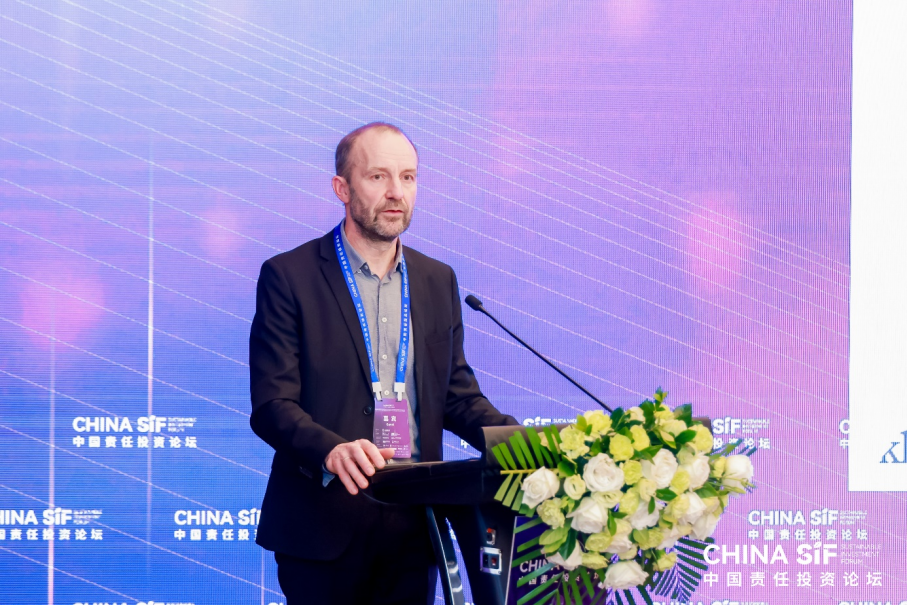
Arild SKEDSMO, Senior Analyst of Responsible Investments at KLP Asset Management participated in the parallel forum A2 on Biodiversity and ESG Investments (TNFD Special). The following is a transcript of his speech.
The Biodiversity Crises and Supply Chain Management
Arild Skedsmo
Dear colleagues, dear organizers, thank you for your invitation to speak on what I believe is one of the most important topics of our time. My name is Arild Skedsmo and I am responsible for climate and nature in the responsible investment team at KLP in Oslo.
KLP is the largest private pension company in Norway and in many ways a typical ‘institutional investor’. We have a broadly diversified portfolio and a long-term investment horizon. Many pension funds and institutional investors are of similar size with similar mandates and investment strategies as us. Individually we only have small shares in thousands of companies, but together investors like us hold around 80% of the public equity marked. When we align expectations and priorities we have a lot of influence, but too often we only speak as small individual shareholders.
My key message will be for companies and investor to align around the goals of the global biodiversity framework - the Kunming-Montreal agreement that was negotiated under joint Chinese and Canadian leadership - and be transparent on ambitions and progress.
This conference has a retrospective entry point. With regards to the burning issue of climate change, I think the summary is simple. If we had responded to the warnings of climate scientist 20 or 30 years back, we would have been in a much safer place today. Now scientists are sounding the alarm bells again.
Deforestation, land conversion, pollution and overexploitation of naturel resources are destroying natures capacity to deliver the fundamental ecosystem services that we all depend on. Far from the 'ecological society' of our visions, we are undermining the conditions for stable societies and functional institutions.
For investors, this is a systemic risk - a threat to the global economy and hence the financial markets at large. (For us, not abouts selecting a green/ESG portfolio, but a responsibility on all companies). To be a bit more specific, I want to briefly touch on two issues that are at the top of our agenda. Food and minerals. Both are fundamentally important to our way of life - but with an inherently large environmental footprint.
Global food production is by far the biggest driver of destruction of the natural environment. Our built-up environment, the cities around us, leave little rom for nature, but in terms of scale, agriculture is of a different order. Meat production is the main culprit.
There is an easy solution this and a potentially more realistic one.
The easy one is to eat less meat. I believe there are huge opportunities for innovative companies to find ways to offer healthy and tasty diets without the extreme inefficiency of passing vegetables through a cow or pig. As you can see from the illustration - we can free up a very large part of today’s farmland just by eating less meat.
The more realistic approach, is to produce more with less impact. This is not utopic. It is about applying existing best practices on already converted land. The main challenge is to make sure that all farmers have access to the knowledge and technology.
In China, as well as my own country and most other places, local impacts of large-scale food production is felt and better practices are continuously implemented. But China is also a major importer of agricultural commodities. This offers an opportunity to influence global production, including in tropical forest areas, where nature loss is happening at the fastest rate. This import is essentially some company's procurement, and procurement is always based on quality standards. Requiring that commodities are produced without deforestation and other harmful social and environmental practices should be a natural part of such standards. There is nothing unreasonable in this. This means traceability and some degree of control throughout the supply chain.
Jumping from soft commodity to mineral extraction. Chinese companies are dominating many raw materials supply chains and thereby providing inputs to a large share of global industry production. (a bit of the opposite situation as with the soft commodity import). The shift toward a low-carbon society based on renewable energy and electricity adds additional demand for certain minerals. This means more mines and more process industry. I think we can be honest enough to admit that extractives don’t historically have the best reputation with regards to managing neither social nor environmental risks.
Fortunately, standards and best practices have developed and improved through decades of experience. We have the knowledge and technology to scale up production without compromising on neither social nor environmental standards. We need to engage with companies and encourage them to build on this experience and apply best practices and be transparent on what they do and how they progress. (Much talk on standards today, including TNFD which we fully support.)
Where direct company contact is challenging, - and to be honest we have mixed experiences - we must ask the questions on supply chain management to their downstream customers. They will then have to be the ones who turn around and ask their suppliers of raw materials to document sustainability all the way back to the mine-site.
To summarise, as investors and owners of companies, we need to ensure that food production and resource extraction is based on the highest standards of social and environmental performance. This is a key financial interest where we are fully aligned with the interest of society at large - the vision of an ecological society. Together we are influential, but we need to more strongly aligned around global goals so that companies hear one clear and consistent message. We also need to be clear that our expectation does not stop at the company gates. Best practice and accountability have to be pushed up through the supply chain. We recognize that this is a journey for many companies, and we have a lot of patience where there is ambitions and will, and we are happy to support when useful. But to maintain credibility throughout the journey requires transparency on ambitions, progress and challenges. That goes for both companies and investors.
We need to understand how companies are performing, and we need to be equally transparent on our progress. Finally, and fundamentally, we strongly believe we are all on the same side here. No-one stands to benefit from the environmental collapse that will come if we don’t act, together, now.
We would like to thank our strategic partners Moody's, AXA SPDB Investment Managers, and partners Sungent Urban Development, Huatai Securities for their support of the 12th China SIF Annual Conference. The supporting organisations: include Bank of Jiangsu; SynTao Consulting; Beijing Enterprise Confederation; CDP China; Global Environmental Institute (GEI); Climate Bonds Initiative (CBI); FAIRR Initiative; Asia Investor Group on Climate Change (AIGCC). The media partners include People's Daily Online; Shanghai Securities; News Sina Finance; The Economic Observer; Caijing Magazine; Stockstar; China Fund News; Jiemian News; Weekly on Stocks; WallStreetCN; Caixin Global; NetEase Finance; Huxiu; qeubee LIVE; Wind 3C Conference; iFinD. China SIF received support from Shanghai Cailian Press; China Climate Engagement Initiative (CCEI); Sustainable Banking and Finance Network (SBFN); Beijing Credit Association; Institute of Finance and Sustainability (IFS); Principles for Responsible Investment (PRI); Aegon Industrial Fund; Yuze Charity; Gems of Wisdom Consulting; BNP Paribas ABC Wealth; CCM CSR Promotion Centre; School of Management and Economics, Chinese University of Hong Kong, Shenzhen; CUEB China ESG Institute; Shenzhen Finance Institute, etc. We extend our heartfelt thanks for their support.
The 12th China SIF Annual Conference serves as the flagship event of the 2024 China SIF Week. Additionally, China SIF Week comprises 9 side events, encompassing a wide range of topics. as The 6th Media Training Workshop on ESG & Green Finance: Capital Market Trends under Green and Low-Carbon Transition, Academic Workshop on ESG, Sustainable Stock Exchange Roundtable (SSER), Seminar on Climate Mitigation Journey and Transition for Financial Institutions, Unlocking Potential Climate Investment: Transition Opportunities in the Energy and Agriculture Sectors, Seminar on ESG Vitality and Impact Investment and Financing: Sustainable Disclosure for Better Business Impact Investment and Financing Development, CCEI Just Transition Seminar Session 3: Just Transition Consideration for Different Sectors and Geographies, China Climate Engagement Initiative (CCEI) Enterprise Visit, and more. Furthermore, China SIF Week also organised working meetings for domestic and international organizations such as CCEI, AIGCC.
Please feel free to follow the China SIF WeChat official account (ChinaSIF), as well as the official account of the organizer, SynTao Green Finance (syntaogf).
For inquiries regarding cooperation intentions with China SIF or requests for information, please contact the organizer at: contact@syntaogf.com.
About China SIF
China Sustainable Investment Forum (China SIF), established in Beijing as a non-profit organisation in 2012, is dedicated to promoting responsible investment and providing an internationalised platform for exchanging and sharing ideas on issues concerning sustainable development, with focus on facilitating Environmental, Social and Governance (ESG) integration, advocating green finance, and contributing to a responsible capital market in China as well as its sustainability.
As a member of the Global SIFs Network, China SIF organises Annual Conferences, Summer Summit, SIF Weeks and a series of featured seminars and webinars annually, convening policymakers as well as domestic and foreign experts to share their views, research, and good practice. Professionals and practitioners from research institutes, financial institutions, listed companies, government agencies, and media representatives have joined our discussion and endeavour to explore multiple ways to promote and practice responsible investment and green finance.
China SIF keeps launching a series of landmark research reports, such as China Sustainable Investment Review, supporting the Dissertation Competition on ESG and Sustainable Finance and developing the "ESG Online Classes" series of educational videos together with partners and industry experts to promote ESG investment concepts and practices. Over the years, China SIF has become one of the most influential responsible investment forums in the region.
Please visit https://en.chinasif.org/ for more information.